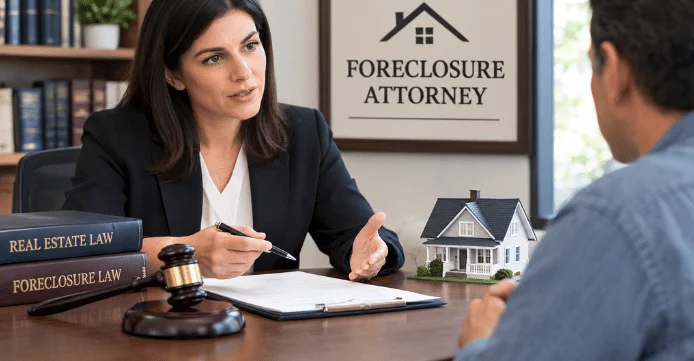
Missing mortgage payments can turn into a legal problem faster than many homeowners expect, especially once formal foreclosure notices begin arriving. A foreclosure attorney can review what the lender or mortgage servicer has done, explain the deadlines that apply where the property is located, and determine whether legal defenses or alternatives deserve closer attention. Getting advice early can be especially important because federal protections, state foreclosure rules, and loss-mitigation deadlines can overlap.
Short answer: A foreclosure lawyer helps homeowners understand foreclosure rules, identify possible lender or servicer errors, negotiate when appropriate, and provide representation in court. Hiring one may be especially valuable after receiving legal papers or a sale notice, when loss mitigation has been mishandled, or when bankruptcy, military protections, or disputed mortgage records could affect the case.
What Does a Foreclosure Attorney Do?
A foreclosure lawyer is an attorney who handles legal issues involving mortgage defaults, foreclosure proceedings, loan servicing disputes, and related homeowner rights. The attorney may represent a homeowner who wants to keep the property, challenge an allegedly improper foreclosure, negotiate a resolution, or understand the consequences of leaving the home. The exact work depends heavily on the homeowner’s goals, the mortgage documents, and the law of the state where the property is located.
One of the first tasks is usually reviewing the loan history and foreclosure documents. That can include the mortgage or deed of trust, promissory note, payment records, default notices, loss-mitigation correspondence, court pleadings, and notices announcing a foreclosure sale. The lawyer can then compare those records with the procedures required under applicable federal and state law.
The attorney may also communicate with the mortgage servicer, prepare responses to a foreclosure lawsuit, raise applicable defenses, participate in mediation, or negotiate over the available alternatives. In some situations, foreclosure problems overlap with bankruptcy, probate, divorce, consumer protection, or real estate law, making coordination with another type of lawyer necessary. Related housing disputes can involve very different rules, as illustrated in WordyWaves’ eviction lawyer guide.
How Foreclosure Works in the United States
There is no single foreclosure process that applies identically throughout the United States. Foreclosures generally fall into two broad categories: judicial foreclosure, which proceeds through the courts, and nonjudicial foreclosure, which can proceed without a foreclosure lawsuit when state law and the mortgage documents permit it. State law controls many important procedures, notices, redemption rights, and timelines.
| Type | Basic process | Why an attorney may matter |
|---|---|---|
| Judicial foreclosure | The lender generally files a lawsuit and asks a court for authority to foreclose. | The homeowner may need to answer the complaint, meet court deadlines, raise defenses, participate in hearings, or negotiate during litigation. |
| Nonjudicial foreclosure | The foreclosure can proceed outside court under a power-of-sale procedure authorized by state law. | Deadlines may move quickly, and a homeowner who wants judicial review may need to take affirmative legal action. |
| Loss-mitigation dispute | The homeowner requests an option such as modification, repayment, forbearance, short sale, or another available alternative. | Counsel can assess whether the servicer followed applicable review and foreclosure-protection requirements. |
Federal mortgage-servicing rules create an important starting point for many borrowers. The Consumer Financial Protection Bureau’s mortgage servicing loss-mitigation rule says that, except in limited circumstances, a mortgage servicer generally cannot make the first notice or filing needed to begin foreclosure until the borrower is more than 120 days delinquent. Once that point is reached, the time between foreclosure initiation and an actual sale depends substantially on state law.
That 120-day period should not be treated as permission to ignore the problem for four months. HUD and the CFPB both encourage homeowners experiencing payment trouble to contact their mortgage servicer as early as possible because more options may be available before the delinquency becomes severe. HUD-approved foreclosure-prevention counseling is also available nationwide.
When Should You Consider Hiring a Foreclosure Attorney?

Legal representation deserves serious consideration once you have received a foreclosure lawsuit, notice of trustee’s sale, sheriff’s sale notice, or another document containing a firm legal deadline. At that stage, missing a response date can reduce the options available even when a potentially valid argument exists. An attorney licensed in your state can identify the actual deadline instead of relying on a general timeline found online.
Hiring counsel may also make sense when the amount the servicer claims you owe appears wrong. Problems involving misapplied payments, unexplained fees, escrow errors, conflicting account histories, or payments made during a loan transfer can require a detailed review of servicing records. A disagreement alone does not automatically create a foreclosure defense, but unexplained inconsistencies deserve investigation before a sale occurs.
Another warning sign is a loss-mitigation application that appears to have been ignored or mishandled. CFPB rules provide specific protections in certain circumstances when a servicer receives a complete application sufficiently before a scheduled foreclosure sale. For example, receiving a complete application more than 37 days before the sale can trigger important restrictions and review obligations, while an application received at least 90 days before a sale may provide an appeal right following certain loan-modification denials.
A lawyer may also be valuable when you believe the foreclosing party has not followed required state notices or procedures. Judicial and nonjudicial foreclosure systems contain different filing, service, publication, timing, and sale requirements. Because those requirements vary from state to state, a defense that works in one jurisdiction may not exist in another.
What Foreclosure Defenses Can an Attorney Investigate?
A foreclosure defense is not simply an argument that losing the home would be unfair or financially difficult. The lawyer generally looks for facts showing that the party pursuing foreclosure lacks the legal right to proceed, failed to follow required procedures, violated applicable servicing protections, or calculated the default incorrectly. Whether any defense is viable depends on the mortgage documents, payment history, applicable law, and evidence.
Potential issues can include defective notices, payment-accounting errors, violations involving protected loss-mitigation applications, questions about the foreclosing party’s authority, and failures to satisfy state-specific foreclosure procedures. Statutes of limitation and contractual requirements can also matter in some cases, although those rules vary significantly by jurisdiction. An attorney should evaluate these issues from the actual case file rather than assuming a commonly discussed foreclosure defense automatically applies.
Servicemembers may have additional protections. The Department of Justice explains that the Servicemembers Civil Relief Act can require a court order before certain nonjudicial foreclosures involving mortgages obtained before military service, and the law contains additional protections involving court proceedings and default judgments. Covered servicemembers facing foreclosure should disclose their military status immediately when seeking legal assistance.
Can an Attorney Stop a Foreclosure?
No lawyer can truthfully guarantee that a foreclosure will be stopped permanently. An attorney may be able to challenge an unlawful process, seek available court relief, negotiate with the servicer, help protect loss-mitigation rights, or use another lawful strategy when the facts support it. The ultimate result depends on the homeowner’s circumstances, state law, loan status, available defenses, financial capacity, and how far the foreclosure has progressed.
Sometimes the most realistic objective is not defeating the foreclosure altogether. A homeowner may instead need enough time to complete a modification review, sell the property, arrange a short sale, negotiate a deed in lieu, or make an orderly transition. A responsible lawyer should discuss both the best-case and likely outcomes rather than promising that litigation will automatically save the home.
HUD specifically warns homeowners about businesses that promise to stop foreclosure immediately or ask borrowers to sign unfamiliar documents. Some foreclosure-rescue schemes can involve large upfront charges or even documents that transfer an ownership interest in the home. Homeowners should read every document carefully and use trusted legal or HUD-approved counseling resources before signing anything significant.
Foreclosure Attorney vs. HUD Housing Counselor
A lawyer and a housing counselor can both help a distressed homeowner, but their roles are different. HUD-approved counselors provide independent assistance with mortgage difficulties, budgeting, communications with servicers, and foreclosure-avoidance options, while attorneys provide legal advice and representation. Foreclosure-prevention counseling through HUD-approved agencies is available free of charge.
| Need | HUD-approved housing counselor | Foreclosure lawyer |
|---|---|---|
| Understand general loss-mitigation options. | Yes. | Yes. |
| Help organize financial information. | Yes. | Sometimes |
| Communicate about mortgage assistance. | Yes. | Yes. |
| Interpret state foreclosure law. | Limited | Yes. |
| Raise legal defenses. | No | Yes. |
| File motions or court pleadings. | No | Yes. |
| Represent yourself in foreclosure court | No | Yes. |
| Provide free foreclosure counseling. | Yes. | Depends on provider |
Using a counselor does not prevent a homeowner from speaking with a lawyer. In fact, a homeowner may benefit from both when the financial problem and the legal problem are developing at the same time. HUD maintains a nationwide network of participating counseling agencies and provides a housing-counseling hotline at 800-569-4287.
Can Bankruptcy Stop Foreclosure?
Bankruptcy can affect a foreclosure, but filing bankruptcy solely because a sale is approaching is a major legal and financial decision. The federal judiciary’s guide to Chapter 13 bankruptcy explains that filing a bankruptcy petition generally creates an automatic stay that stops most collection activity, and Chapter 13 can sometimes allow an individual to bring past-due mortgage payments current over time. However, exceptions exist; creditors can sometimes seek relief from the stay, and a completed foreclosure sale may change what bankruptcy can accomplish.
A foreclosure lawyer who does not regularly practice bankruptcy law may refer the homeowner to a bankruptcy attorney. That consultation can help determine whether Chapter 13, Chapter 7, or no bankruptcy filing fits the homeowner’s actual financial circumstances. Bankruptcy should not be presented as a guaranteed foreclosure cure because eligibility, timing, future payment ability, and the status of the sale all matter.
How Much Does a Foreclosure Attorney Cost?
Foreclosure legal fees vary considerably by location, case complexity, and the work required. A 2025 Nolo consumer guide reports that foreclosure defense lawyers commonly use hourly, flat-fee, or monthly billing arrangements, with broad estimates of roughly $100 to $500 per hour and flat fees of approximately $1,500 to $5,000 or more. These are market estimates rather than a national fee schedule, so an individual attorney’s quote may fall outside those ranges.
A lower quoted fee does not necessarily mean a lower total cost. Homeowners should find out whether the price covers only document review or whether it also includes answering a lawsuit, hearings, mediation, discovery, loss-mitigation work, negotiations, and trial preparation. The written engagement agreement should also explain filing fees, expert expenses, copying charges, and any other costs billed separately.
Homeowners who cannot afford full representation may still have alternatives. Depending on income and location, legal-aid organizations, foreclosure clinics, limited-scope representation, or a one-time attorney consultation may provide lower-cost assistance. HUD-approved foreclosure-prevention counseling is another free resource, although a counselor cannot substitute for a lawyer when court representation or legal advice is required.
How to Choose the Right Foreclosure Lawyer
The most useful question is not simply how many years a lawyer has been licensed. Ask how much of the lawyer’s current practice involves homeowner foreclosure defense, whether the lawyer handles cases in your county, and whether the attorney has worked with the type of foreclosure procedure affecting your property. WordyWaves’ broader elder law attorney guide uses a similar principle: the lawyer’s experience should match the specific legal problem rather than only the general practice category.
| Question to ask | What the answer can reveal |
|---|---|
| How much of your practice involves foreclosure defense? | Whether the attorney regularly handles these cases |
| Have you handled cases involving my mortgage servicer or similar facts? | Practical familiarity with comparable disputes |
| What deadlines apply to my case right now? | Whether the attorney has reviewed the immediate risk |
| Do you see a possible legal defense? | Whether litigation has a factual and legal basis |
| What outcome should I realistically expect? | Whether the lawyer is avoiding guarantees and discussing tradeoffs |
| How will you charge me? | The likely financial commitment |
| Who will personally handle my case? | Whether work will be performed by the lawyer you meet |
| What should I do before the next deadline? | Whether the consultation produces a concrete action plan |
Verify that the lawyer is licensed and in good standing through the appropriate state licensing authority before signing an agreement. The American Bar Association also maintains directories of state and local bar-sponsored lawyer referral resources, which can provide another starting point for finding counsel. Referral services can be particularly helpful when a homeowner does not already know a local lawyer who practices foreclosure defense.
What to Bring to a Foreclosure Consultation
A lawyer can evaluate the situation more efficiently when the important documents are available at the beginning. Useful records include the promissory note and mortgage or deed of trust, recent mortgage statements, payment history, default letters, acceleration notices, loss-mitigation applications, modification decisions, certified-mail receipts, emails with the servicer, foreclosure complaints, summonses, and sale notices. If something is missing, bring what you have rather than delaying the consultation while trying to build a perfect file.
Also prepare a simple timeline of what happened. Include when payments became difficult, when the first payment was missed, when you contacted the servicer, what assistance you applied for, what the servicer requested, and any scheduled court or sale dates. A chronological record can make it easier for counsel to spot inconsistencies or time-sensitive issues.
What Should You Do If Foreclosure Has Just Started?
Start by reading every notice instead of assuming it is another collection letter. Identify the sender, date, response deadline, court information, amount claimed due, and any announced foreclosure-sale date. Keep the envelope as well because mailing dates and delivery methods can occasionally matter.
Next, contact the mortgage servicer and ask what loss-mitigation options are currently available. The CFPB says servicers generally must provide information about available options and have specific contact and notice obligations for many delinquent borrowers. Options may include repayment plans, forbearance, loan modification, short sale, or deed in lieu depending on the loan and circumstances.
Finally, contact a HUD-approved housing counselor and consider a local foreclosure lawyer when legal papers, disputed servicing, a scheduled sale, or another significant issue is involved. Do not assume an internet article can calculate the deadline in your state. WordyWaves’ Law section provides additional general legal education, but case-specific decisions should come from qualified counsel licensed in the relevant jurisdiction.
Frequently Asked Questions
Do I need a lawyer after one missed mortgage payment?
Not necessarily, because one missed payment does not ordinarily mean a foreclosure lawsuit or sale is immediately underway. Contacting the servicer and a HUD-approved counselor early can help you explore available assistance before the problem becomes more serious. A legal consultation becomes more important when you receive formal foreclosure documents, dispute what the servicer is doing, or believe special legal protections apply.
How long before a lender can start foreclosure?
For many mortgages covered by federal servicing rules, a servicer generally cannot make the first notice or filing required to begin foreclosure until the mortgage is more than 120 days delinquent. Important exceptions exist, and state law governs much of the process after foreclosure begins. The timeline from the first formal foreclosure step to a sale therefore differs substantially throughout the United States.
Can a foreclosure lawyer negotiate a loan modification?
An attorney can communicate with a mortgage servicer and assist with legal issues related to a loss-mitigation application, but no attorney can guarantee that a modification will be approved. Approval depends on the loan program, investor requirements, financial information, and available loss-mitigation options. HUD-approved counselors can also help homeowners navigate the application process without charging for foreclosure-prevention counseling.
Is it too late to hire a lawyer after a foreclosure sale is scheduled?
Not automatically, but the amount of time remaining matters greatly. Federal loss-mitigation protections can change as a scheduled sale gets closer, and state deadlines may require action well before the sale date. Contacting qualified local counsel quickly is safer than assuming a last-minute filing will stop the sale.
Can I fight foreclosure without an attorney?
Some homeowners handle portions of the process themselves, particularly when the issue primarily involves communicating with the servicer or completing a loss-mitigation application. Contested foreclosure litigation, complicated servicing disputes, or urgent sale deadlines can be much harder to navigate without legal training. Free counseling, legal aid, limited-scope assistance, and bar-sponsored referral programs may help when full representation is unaffordable.
The Bottom Line
A foreclosure attorney is most valuable when the problem has moved beyond a simple missed payment and into disputed servicing, formal foreclosure proceedings, court deadlines, or a scheduled sale. The lawyer’s job is not to promise that every homeowner can keep the property but to identify the law that applies, protect available rights, evaluate realistic defenses, and help the homeowner make an informed decision. Acting early usually leaves more room to investigate alternatives than waiting until the final days before a sale.
If you are behind on your mortgage, contact the servicer, open every notice, preserve your records, and use free HUD-approved foreclosure counseling as soon as possible. If you have received legal papers, believe the servicer has violated applicable rules, are protected by military-service laws, or face an imminent foreclosure sale, consider speaking promptly with an attorney licensed where the property is located.