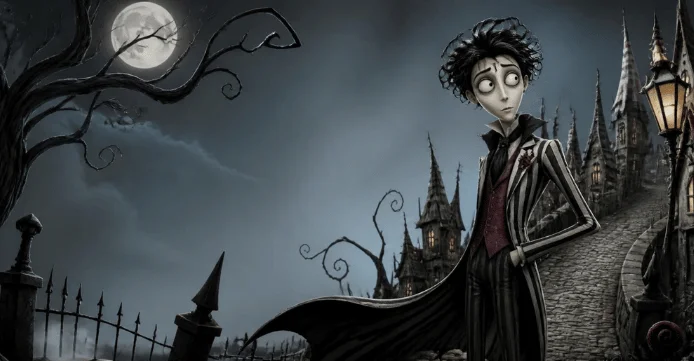
A Tim Burton character is rarely difficult to recognize. Pale faces, unusual silhouettes, dark clothes, and expressive eyes often provide the first clues. Yet Burton’s most memorable figures stand out because their emotional lives are as distinctive as their appearances.
Edward Scissorhands, Beetlejuice, Jack Skellington, Lydia Deetz, and the Corpse Bride are among the names closely associated with his work. Some were created by Burton, while others came from existing stories or collaborations. Together, they reveal his fascination with outsiders, misunderstood monsters, loneliness, imagination, and finding a place to belong.
Quick answer: A typical Tim Burton character combines an unusual appearance with loneliness, curiosity, or social isolation. Edward Scissorhands is perhaps the clearest example. Jack Skellington, Lydia Deetz, Beetlejuice, Emily from Corpse Bride, and Burton’s versions of Batman and Catwoman also reflect parts of his recognizable character style.
Tim Burton Characters at a Glance
| Character | Movie | Key Trait | Why the Character Stands Out |
|---|---|---|---|
| Edward Scissorhands | Edward Scissorhands | Gentle outsider | His frightening appearance contrasts with his kindness. |
| Beetlejuice | Beetlejuice | Chaotic trickster | He mixes horror, comedy, and grotesque visual humor. |
| Lydia Deetz | Beetlejuice | Gothic outsider | She understands the supernatural better than the adults |
| Jack Skellington | The Nightmare Before Christmas | Restless dreamer | His curiosity pushes him beyond his familiar world. |
| Sally | The Nightmare Before Christmas | Thoughtful rebel | She sees danger before others and seeks independence. |
| Emily | Corpse Bride | Tragic romantic | Her macabre design hides a sympathetic personality. |
| Victor Van Dort | Corpse Bride | Nervous outsider | His awkwardness drives much of the story. |
| Batman | Batman / Batman Returns | Isolated hero | Burton emphasizes Bruce Wayne’s loneliness and dual identity. |
| Catwoman | Batman Returns | Reinvented outsider | Selina Kyle transforms physically and emotionally. |
| Victor Frankenstein | Frankenweenie | Young inventor | Grief and devotion lead him toward a strange experiment. |
What Makes a Tim Burton Character So Recognizable?
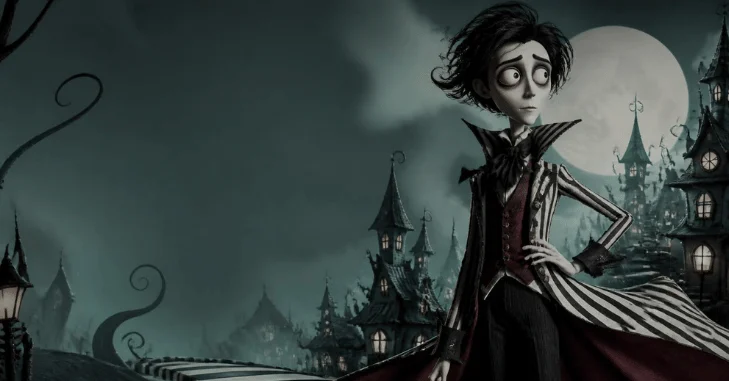
Burton’s characters often look as though they belong somewhere between a Gothic illustration and an old horror film. Thin bodies, dark eye circles, black clothing, exaggerated hair, scars, and angular shapes appear repeatedly. His animated figures can push these features even further because their proportions do not need to follow reality.
Appearance is only part of the pattern. Many central figures are isolated from the ordinary communities around them. Museums and critics examining Burton’s work have repeatedly connected his films with outsiders, masks, altered bodies, fantasy, and unusual creatures.
That emotional pattern matters more than any single costume detail. A strange-looking person may prove compassionate, while respectable neighbors can become cruel or selfish. Burton frequently uses that contrast to make audiences reconsider who the real outsider or “monster” is.
Edward Scissorhands Is the Defining Tim Burton Character
Edward Scissorhands may be the clearest expression of Burton’s character style. Johnny Depp plays an artificial young man whose inventor dies before giving him ordinary hands. Edward enters suburbia with blades for fingers, an intimidating appearance, and an unexpectedly gentle personality.
His design immediately communicates separation from everyone around him. Black leather, scars, wild hair, and metal blades contrast sharply with the pastel neighborhood that temporarily welcomes him. The visual difference becomes a simple way to show how far Edward stands outside conventional society.
His personality creates the more important contrast. Edward makes sculptures, trims hedges, styles hair, falls in love, and tries to connect with people. His dangerous-looking hands can create beauty, while the supposedly normal community eventually turns against him.
Burton’s official biography describes Edward Scissorhands as perhaps his most beloved film and calls it quintessentially “Burtonesque.” The movie also began Burton’s long-running screen collaboration with Johnny Depp. That history helps explain why Edward remains such a useful starting point for understanding Burton’s fictional outsiders.
Beetlejuice and Lydia Deetz Show Two Sides of Burton’s World
Beetlejuice represents a much louder type of Burton figure. Michael Keaton’s supernatural troublemaker is theatrical, unpredictable, selfish, and deliberately grotesque. Rather than asking audiences for sympathy, he turns the strange afterlife of the movie into anarchic comedy.
Lydia Deetz offers the opposite energy. Played by Winona Ryder, Lydia is quiet, observant, and comfortable with subjects that unsettle the adults around her. Her Gothic appearance reflects her sense that she does not fit comfortably into the ordinary world.
Putting Lydia beside Beetlejuice shows how broad Burton’s character design can be. One figure is restrained and emotionally isolated, while the other seems incapable of restraint. Both make the supernatural feel more interesting than the supposedly normal environment surrounding it.
Fans interested in how performers shape memorable horror personalities can also read WordyWaves’ guide to the cast of M3GAN. That film uses a different visual language, but character performance remains central to its horror.
Jack Skellington Turns an Outsider Into a Restless Leader
Jack Skellington is the Pumpkin King of Halloween Town and the protagonist of The Nightmare Before Christmas. Burton created the story and characters, although Henry Selick directed the 1993 feature. Chris Sarandon provided Jack’s speaking voice, while Danny Elfman performed his singing voice.
Jack differs from Edward because his community already admires him. His problem is not rejection by other people. Instead, he feels dissatisfied with the identity everyone expects him to repeat.
Discovering Christmas gives that dissatisfaction a direction. Jack becomes fascinated by something bright, unfamiliar, and outside his established role. His attempt to recreate it produces chaos, but the experience eventually gives him a clearer understanding of himself.
That story makes Jack one of Burton’s most accessible outsiders. You do not need scissors for hands or a home in Halloween Town to understand boredom with an established identity. His skeletal design makes him fantastical, while his restlessness keeps him emotionally familiar.
Sally Brings Quiet Strength to Halloween Town
Sally is visually connected to Halloween Town, but her personality differs from its louder residents. She is a stitched rag-doll woman created by Dr. Finkelstein. Her patchwork body makes her visibly artificial, yet she often understands emotional consequences better than the people around her.
Her story also centers on independence. Sally wants control over her movements and choices rather than remaining confined by her creator. That desire gives her a role beyond being Jack’s romantic interest.
She also recognizes the danger in Jack’s Christmas plan. While Jack races toward a new obsession, Sally watches, questions, and tries to intervene. Her intelligence makes her one of the quieter but more grounded figures associated with Burton’s animated world.
Emily and Victor Give Corpse Bride Its Gothic Heart
Corpse Bride turns death into a colorful social world rather than treating it only as something frightening. Emily, the title character, is visibly dead and carries the marks of tragedy. Yet her humor, vulnerability, and generosity gradually become more important than her macabre appearance.
Victor Van Dort is a different type of misfit. He is shy, anxious, and uncomfortable with the formal expectations surrounding his arranged marriage. His accidental proposal to Emily pulls him into the land of the dead and forces him to confront choices he previously avoided.
The pairing reflects a recurring Burton idea. Strange circumstances reveal emotional truths that ordinary social rules conceal. MoMA includes Corpse Bride among the canon of beloved figures associated with Burton’s distinctive filmmaking.
Batman and Catwoman Became Burton-Style Outsiders
Not every memorable Burton figure originated with him. Batman existed for decades before Burton directed Batman in 1989. Yet his films placed unusual emphasis on masks, isolation, psychological conflict, and the theatrical darkness of Gotham.
That approach becomes even clearer in Batman Returns. Bruce Wayne, Selina Kyle, and the Penguin each exist at different distances from conventional society. Their costumes and transformed identities make inner conflicts physically visible.
Catwoman is especially compatible with Burton’s recurring interests. Selina’s transformation changes her clothing, behavior, confidence, and relationship with social expectations. She becomes another example of a character whose external strangeness reflects a deeper struggle over identity.
This distinction is useful when discussing Burton’s filmography. Calling every figure in one of his movies a character he personally created would be inaccurate. His influence can come through direction, production design, performance, costume, atmosphere, and reinterpretation of an existing figure.
Why Outsiders Appear So Often in Burton’s Movies
Burton grew up in Burbank, California, and studied character animation at CalArts before working at Disney. His early short Vincent already featured a boy whose imagination separated him from ordinary surroundings. That interest in unconventional characters continued across his live-action and animated work.
The outsider theme also gives his movies emotional flexibility. Characters can be funny, frightening, sympathetic, or all three without losing their identity. Audiences are often encouraged to look beyond an unusual face or body before deciding what kind of person they are watching.
This approach connects character design with storytelling. Burton does not use dark clothes, exaggerated proportions, or scars only as decoration. Those visual choices often tell you something about loneliness, transformation, vulnerability, or the gap between a character and society.
WordyWaves readers exploring other creators known for distinctive television characters can see the site’s Ryan Murphy career and shows guide. The genres differ, but both creators have become strongly associated with recognizable visual and character-driven worlds.
Created by Burton vs. Reinterpreted by Burton
A useful distinction separates Burton-created figures from characters strongly associated with his directing work. Edward Scissorhands and the world behind The Nightmare Before Christmas grew directly from his creative imagination. Characters such as Batman, Willy Wonka, Sweeney Todd, and Alice existed before Burton adapted their stories.
That difference does not erase his influence on the latter group. Costume, production design, casting, color, movement, and performance can make an existing character fit comfortably inside a Burton film. His movies often filter familiar source material through his established visual interests.
This is why “Burtonesque” can describe more than authorship. It can refer to an aesthetic built around Gothic imagery, eccentric humor, emotional outsiders, altered bodies, and fantasy. MoMA’s retrospective similarly treated his drawings, films, costumes, puppets, and concept art as connected parts of one creative vision.
Why These Characters Still Connect With Audiences
The visual designs make these figures easy to remember, but appearance alone cannot explain their longevity. Edward wants acceptance, Jack wants purpose, Sally wants independence, and Lydia wants to be understood. Those desires remain recognizable even when the stories involve ghosts, skeletons, artificial humans, and talking corpses.
Burton also allows unusual characters to remain unusual. Acceptance does not always require turning them into conventional heroes. Edward, for example, does not become physically ordinary before the story asks viewers to care about him.
That idea gives the movies an emotional appeal beyond Gothic style. People who have felt awkward, isolated, misunderstood, or confined by expectations can recognize parts of themselves in exaggerated fictional figures. The characters look strange, but their conflicts often feel familiar.
For another example of fictional entertainment influencing wider popular culture, WordyWaves covers the history and meaning of Galentine’s Day. The tradition began with a television story before audiences carried the idea into everyday life.
Frequently Asked Questions About Tim Burton Characters
What is the most famous Tim Burton character?
Edward Scissorhands is one of the strongest candidates because the character combines Burton’s visual style with his recurring outsider theme. Burton’s official website describes the film as quintessentially “Burtonesque.” Jack Skellington and Beetlejuice are also closely associated with his creative identity.
Did Tim Burton create Jack Skellington?
Yes, Jack originated from Burton’s story and creative work behind The Nightmare Before Christmas. Burton developed and produced the movie, while Henry Selick directed the feature. Danny Elfman supplied Jack’s singing voice, and Chris Sarandon provided his speaking voice.
What do Tim Burton characters usually look like?
Many have pale complexions, dark clothing, exaggerated proportions, messy hair, scars, or prominent eyes. Those features are tendencies rather than rules. His filmography also includes colorful, polished, or familiar characters that do not match the stereotypical Gothic appearance.
Why are so many Tim Burton characters outsiders?
Isolation lets Burton contrast unusual individuals with supposedly ordinary communities. Characters such as Edward make that contrast especially clear. Their stories often explore acceptance, identity, loneliness, creativity, and the consequences of judging someone by appearance.
Is Wednesday Addams a Tim Burton character?
No, Wednesday Addams was created by cartoonist Charles Addams decades before Burton worked on the Netflix series Wednesday. Burton directed several episodes and served as an executive producer, but he did not create the character. His involvement represents another example of applying his directing sensibility to an established fictional figure.
The Lasting Appeal of Burton’s Misfits
The most memorable Burton figures work because their unusual designs support recognizable emotions. Edward’s loneliness, Jack’s restlessness, Sally’s desire for freedom, and Lydia’s alienation give audiences something human beneath the Gothic imagery. Their stories make strangeness part of their identity rather than a problem that always needs fixing.
That combination has helped Burton build one of cinema’s most recognizable creative signatures. Start with Edward Scissorhands if you want the clearest example, then compare him with Jack, Lydia, Sally, Emily, and Burton’s reinterpretations of established characters. The similarities reveal a creative world where outsiders frequently become the people worth understanding most.